Welcome!

Welcome! This is a work in progress. This site has been dormant since 2009, and is now being revived. Please keep checking back to see what is new. Thank you. ~ Kathy M. ~ July 10, 2015

Sunday, November 15, 2009

Curriculum - Social and Emotional Development:


Tucker the Turtle Helps Children 
with Self-Regulation of Emotions

Now back in the classroom after eight years out of it,  I have been busy learning about what is new since I left.  I spent the first weekend in May attending at NEAYC convention in Bend, Oregon and received a kick-start on teaching tools and ideas.

Tucker the Turtle is a big deal right now, teaching children how to stop before reacting by taking three deep breaths, going into their shell, and thinking of options other than lashing out at their friends.  Once thinking of another option, the kids learn to ask themselves, "Is it kind?  Is it safe?  How will it make other people feel?"


I went online to find out more, made myself a notebook by printing off what I found.  I also went to the local toy store and bought some turtles, and then assembled a basket that is all ready to use during circle time.


These guys are adorable, and are easy to find right now.  I named the big one Tucker, the little one Teri and the one in his shell Timmy.  You can also find a turtle hand-puppet to use instead, as the woman in the video below did.

Here is one example of a lesson plan that you can use if you want to: 

Source: University of Wisconsin, 4K Leaps

I tried this for the first time with three kids yesterday.  They were very receptive.  My group consisted of a 2 1/2 year-old, a 3 1/2 year-old and a 5 year-old.  First, we practiced our deep breathing technique.  I used an artificial flower and an unlit candle.  All you do is smell the flower and then blow out the candle.  Easy-peasy, for the older two.  The little one tried her best to smell the flower, but she kept blowing on it instead.  Sometimes I still forget how the easiest things to me might be the hardest ones for somebody else.


We practiced three deep breaths, curling into a ball, thinking of an option that wouldn't hurt anybody, and then re-read the story.  We also have a poster on our circle time board that shows a variety of options:


1.  Play together
2. Share
3. Say, "Please stop."
4. Ignore
5. Get a timer.
6. Trade
7. Wait and take turns.
8. Ask nicely.
9. Say, "Please."
10. Get a teacher.   

Here is a YouTube video that gives more 
ideas on how to teach the turtle technique: 


I hope that this helps!

~ Kathy Matthews
@ All Rights Reserved
Please do not use my photographs without permission.
Thank you! 

Links:


Protected by Copyscape Online Plagiarism Software


Curriculum - Math:


Protected by Copyscape Originality Check


Curriculum - Language and Literacy:


Language Skills and Your Two-Year-Old
Language skills for two-year-olds are blossoming. They can understand and say hundreds of words, but familiar adults may need to "translate" for others due to immature pronunciation skills. During the year, they pick up most parts of speech to form more complete sentences. They understand simple directions and many common phrases used in routine situations. Children this age rarely initiate conversations, but they answer adult questions more readily and need less prompting.
Receptive Vocabulary (words recognized when heard or seen)
  • At 24 months, understands 500 to 700 words; by 30 months, as many as 800 or 900.
  • The average child has the capacity to acquire one or two words per day, given access to new words in his or her daily experiences.
  • Learns a considerable number of words when adults name objects. During this year, begins to also infer word meanings from their context in adult conversations.
  • Vocabulary words include many nouns (names of things, such as common objects and familiar people), and an increasing number of action words, descriptive words, pronouns and location words. Children also typically learn quantifiers (e.g., more, all, some) and question words (e.g., why, where, who, when).
Language Comprehension
  • Understands a lot of common phrases used in routine situations.
  • Follows one- and two-step directions involving very familiar objects and actions (e.g., "Get your hat." "Put your book back on the shelf.", "Take off your mittens and tuck them in your hat.", "Pick up the book and bring it here.")
  • Understands simple explanations in routine contexts.

Speech Sound Perception
  • Perception of speech sounds that aren't used in native language continues to decrease. Exposure to a second or a third language helps children to continue to perceive a wider range of speech sounds, making learning a second language easier.
  • Begins to mimic the spoken language styles of familiar adults.
Expressive/Productive Vocabulary (words used when speaking or writing)
  • At 30 months, the average child says about 570 words.
  • Continues to over- and under-extend the meanings of words (e.g., a child calls a cow "horsie"), but to a lesser degree for more frequently occurring items.
Pronunciation
  • From 24 to 36 months, pronunciation improves considerably, although certain sounds in certain positions in words are still hard for many children. Parents and caregivers may need to "translate" for others. Children at this age often enjoy chanting, repeating syllables over and over in a sing-song way to explore language sounds.
Grammatical Development
  • For the first half of this year, children continue to communicate in sentences that lack parts of speech. By the end of the year, children have picked up most of the parts of speech that make for full and grammatical sentences (e.g., says, "Mommy is getting her purse," instead of, "Mommy purse.").
Sharing Personal Experiences

  • Adults must continue to provide guidance when helping a child share a personal experience. Children can increasingly provide more in response to initial questions, but many details still need prompting (e.g., "And where did we eat ice cream? Where were we?")  


Protected by Copyscape Originality Check

Curriculum - Physical Development and Health


Protected by Copyscape Originality Check

Creating Your Inside Enviornment: Activity Areas


These are the two classrooms that I had at New Generations Child Development Center in Sunriver, Oregon.  At first I taught the 2's/3's class, "The Rabbits", and then I taught the preschoolers, "The Mustangs".  

Welcome to The Rabbits Room (2's/3's):


The Rabbits Room Art and Writing Area:


The Rabbits Room Block and Manipulative Area:


The Rabbits Room Circle Area and the workbench in the Block Area:


The Rabbits Room Circle Area on the left and Discovery Center on the right:


The Rabbits Room Block Area and Manipulatives:


The Rabbits Room Large Group Area: 


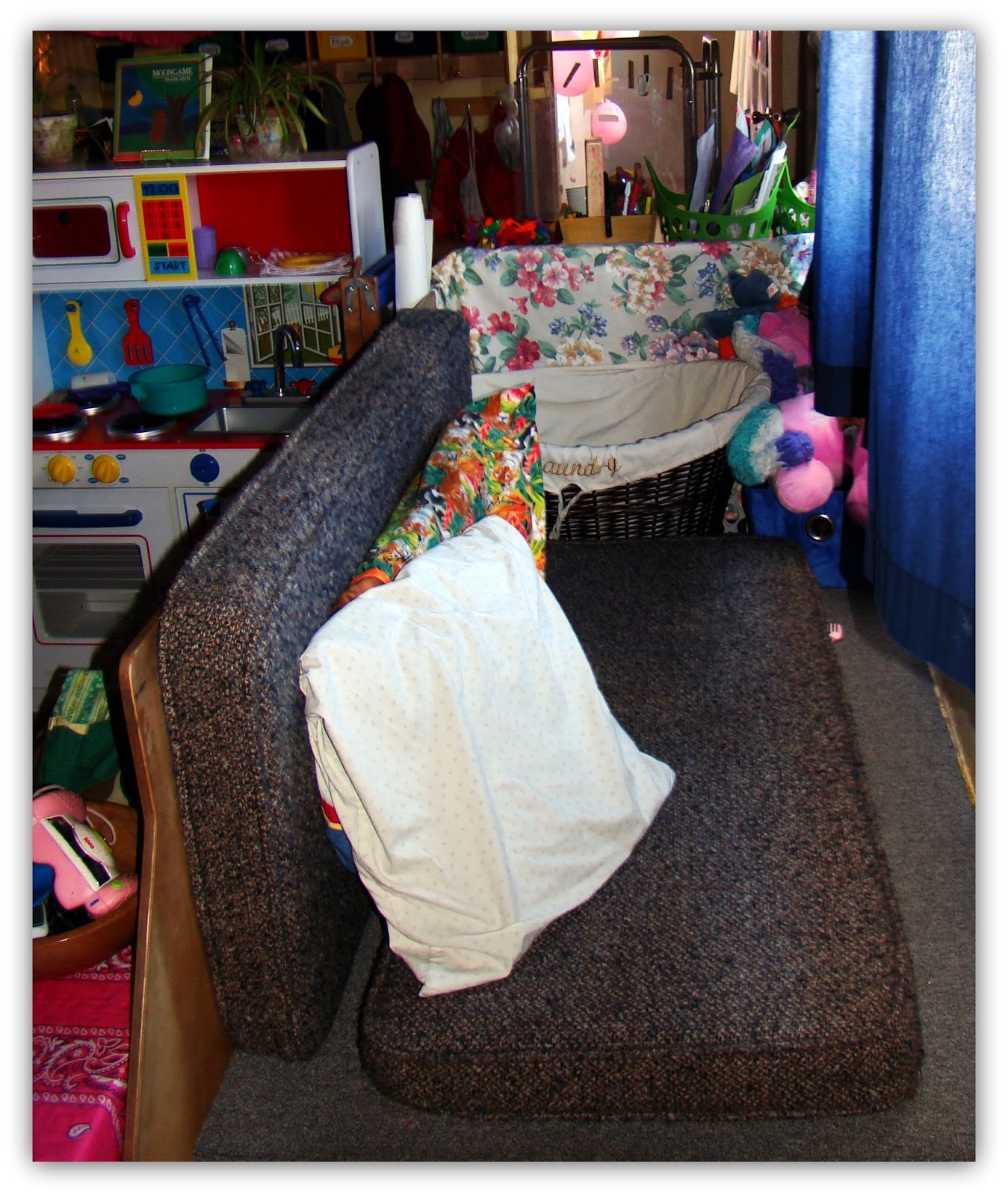
 The Rabbits Room Dramatic Play:


The Rabbits Room Reading and Quiet Areas:


The Rabbit's Room Music and Dance:


The Rabbits Room Science/Discovery Area:


The Rabbits Room Water and Sand Table:

Sensory Area (when not in use, the sensory table is under the cubbies). 


The Rabbit's Room Dining:


Rabbits Room Handwashing/Diaper Changing Area:


*****************************************


Welcome to The Mustangs Preschool Room (3's/4's/5's):


The Mustangs Room Large Group Area: 


The Mustangs Room Quiet Area:


The Mustangs Room Dramatic Play and Blocks:


The Mustangs Room Dining, Art, Writing Area:


The Mustang's Room Sensory/Science and Discovery and Manipulatives:


The Mustangs Room before the loft came down:


Science and Discovery

Sensory Area

Art and Playdough Area


Art Area
Dramatic Play, Puzzle Area and Large Group/Circle Area in background.


Dramatic Play Block Area and Loft/Quiet Area

Block Area
Block Area

Block Area

Reading Nook in Loft

Quiet Area in Loft with Stuffed Animals

Handwashing Sink, Clothseline for Art and Tables for Eating, Art and Writing


Large Group/Circle Time and Music Area


 Protected by Copyscape Originality Check